
TOKENOMICS
Our goal is to make using Web3 as easy as possible
This section will be completed soon.
Rumble Bees uses a multi-token system as its in-game currency. The combination of these several tokens supports a balanced and efficient tokenomics, providing functionality, governance, and liquidity.
$RBN (Nectar)
This section will be completed soon.
$RBH (Honey)
This section will be completed soon.
$RBJ (Royal Jelly)
This section will be completed soon.
$RBT (Governance Token)
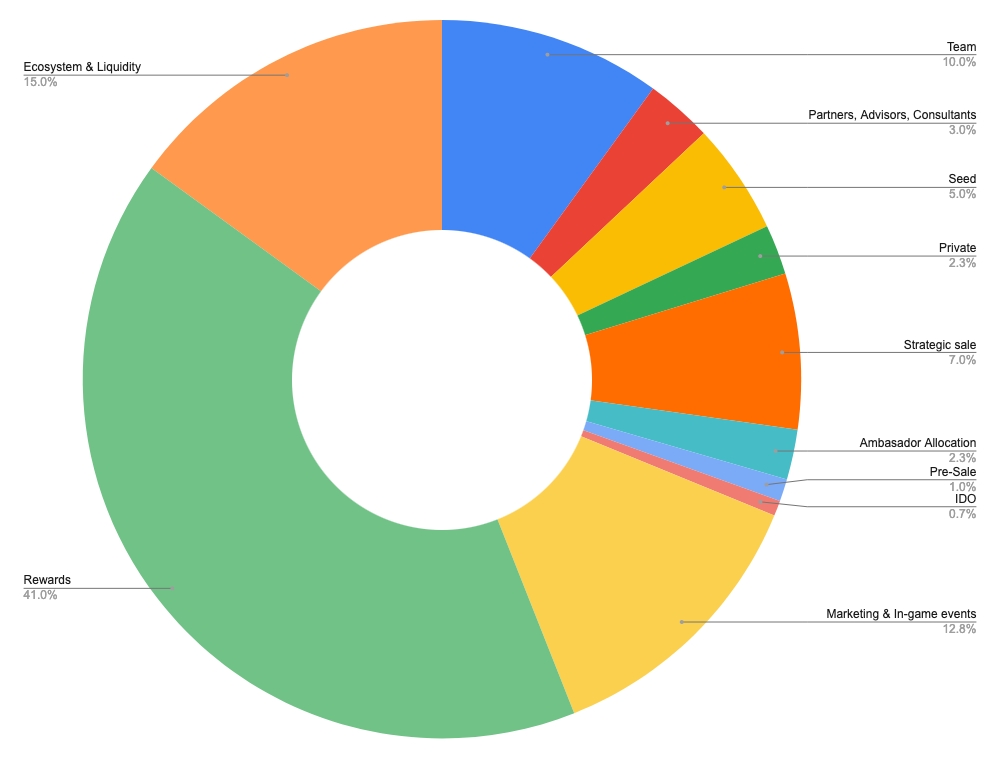
$RBT is an Rumble Bees governance token, hat has a limited issue of 5,000,000,000. The token based on the SOLANA Blockchain. The token is listed through IEO and actively circulates on CEX and DEX outside the game.
Total Supply
5,000,000,000
100%
$75,000,000
Team
500,000,000
10%
$7,500,000
Partners
150,000,000
3%
$2,250,000
Seed
250,000,000
5%
$3,750,000
Private Sale
112,500,000
2.25%
$1,687,500
Strategic Sale
350,000,000
7%
$5,250,000
Allocation
112,500,000
2.25%
$1,687,500
Pre-Sale
50,000,000
1%
$750,000
IEO
35,000,000
0.7%
$525,000
Marketing
640,000,000
12.8%
$9,600,000
Rewards
2,050,000,000
41%
$30,750,000
Liquidity
750,000,000
15%
$11,250,000
Total
910,000,000
-
$7,437,500
-
Seed
250,000,000
$0.005
$1,250,000
$25,000,000
Private Sale
112,500,000
$0.007
$787,500
$35,000,000
Strategic Sale
350,000,000
$0.009
$3,150,000
$45,000,000
Allocation
112,500,000
$0.010
$1,125,000
$50,000,000
Pre-Sale
50,000,000
$0.012
$600,000
$60,000,000
IEO
35,000,000
$0.015
$525,000
$75,000,000
Important Note: $RBT token does not represent any interest, participation, rights, title in the project or the company, their branches or any other company, enterprise. $RBT token does not give token holders the right to any commissions, dividends, income, profits or return on investment, and is not intended to create securities in any jurisdiction. $RBT token can only be used in the Rumble Bees project services, and ownership of it does not carry any rights, explicit or implied, except the right to use $RBT token as a means to use the Rumble Bees project services and interact with it. $RBT token pricing in the secondary market does not depend on the UNICORN MEGACORP team, and there is no functionality or scheme designed to control or manipulate secondary prices.
$RBT token is locked in the vesting smart contract and its unblocking occurs on every 7th day of the month according to the tokenomics.
Team
12 month cliff, 4% unlock every month, 52 month
Partners
4 month cliff, 3% unlock every month, 52 month
Seed
4% unlock at IEO, 4 month cliff, 2% unlock every month, 52 month
Private Sale
5% unlock at IEO, 4 month cliff, 5% unlock every month, 52 month
Strategic Sale
5% unlock at IEO, 2 month cliff, 3.5% unlock every month, 52 month
Allocation
6% unlock at IEO, 1 month cliff, 5% unlock every month, 52 month
Pre-Sale
6% unlock at IEO, 1 month cliff, 5% unlock every month, 52 month
IEO
10% unlock at IEO, 1 month cliff, 5% unlock every month, 52 month
Marketing
4% unlock at IEO, 1 month cliff, 4% linear unlock, 52 month
Rewards
2.5% unlock at IEO, 1 month cliff, 2.5% linear unlock, 52 month
Liquidity
0,6% unlock at IEO, 1 month cliff, 2% linear unlock, 52 month
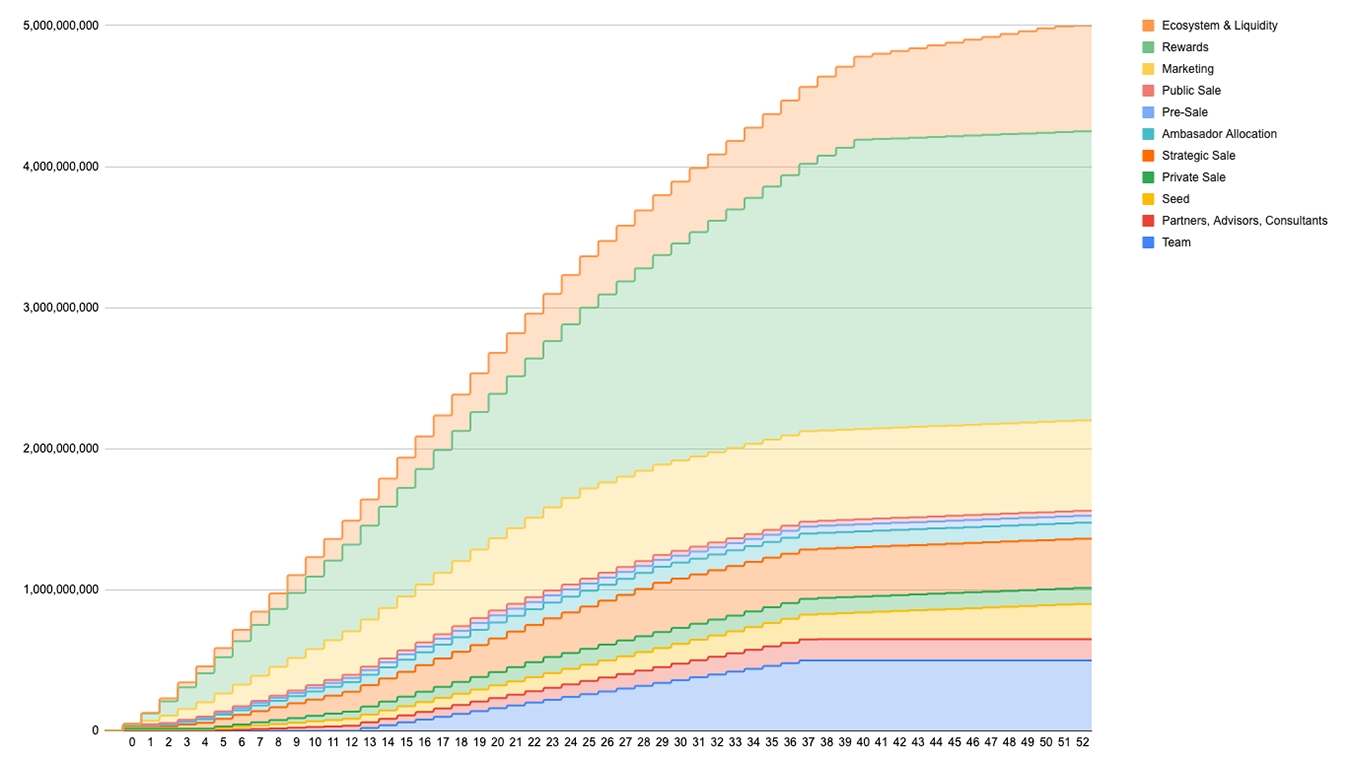
Wallet owners who acquired tokens in the presale rounds can request monthly information about the available tokens held in the contract and initiate their unlocking by transferring tokens from the main wallet to their personal wallets. The tokens will remain at the main wallet until the request is made.
AUDIT
This section will be completed soon.
WEB3 PARTNERS
This section will be completed soon.
LISTING
This section will be completed soon.
BURNED
This section will be completed soon.
STAKING
This section will be completed soon.
F.A.Q.
Frequently Asked Questions about web3
Mass Adoption. In the context of cryptocurrencies refers to the extensive use and integration of digital currencies into everyday transactions and activities, including but not limited to purchasing goods and services, financial investments, remittances, and other financial transactions. Additionally, it implies the widespread acceptance and implementation of blockchain technology across various industries and sectors, leading to significant changes in operational processes and business models.
Web3. The concept of "next-generation internet", enabled by blockchain and its services. In this context, users not only consume content but also become its creators and proprietors, acquiring exclusive rights and opportunities for monetization. Moreover, they actively participate in project management, utilizing crypto tokens for voting purposes.
Blockchain. Revolutionizes data storage with its decentralized system. Acting as a distributed ledger, it disperses data across multiple networked computers. Every transaction within the network is permanently recorded on the blockchain, ensuring transparency and accessibility to all interested parties. Its decentralized nature eliminates the need for a central authority, fostering trust and security in digital transactions.
Token. Represents a unit of account, comprising a specific set of symbols recorded within the blockchain. It serves as a digital representation of your balance in a particular asset, providing a record of your ownership and the quantity of the asset you possess.
NFT. Non-Fungible Token, is a unique blockchain token, unlike fungible ones that are interchangeable. In crypto-games, NFTs represent exclusive in-game assets like characters or items, ensuring their scarcity and uniqueness. Players own and trade these digital assets, enhancing the gaming experience and creating a thriving virtual economy.
Gas. In blockchain, gas fee measures the computational resources needed for operations. It determines transaction costs, reflecting the complexity of tasks. Gas acts as fuel for blockchain actions, ensuring network functionality. Users adjust gas fees based on transaction priorities and network conditions.
Tokenomics. A blend of "token" and "economics," refers to the characteristics of crypto-token supply and demand. Unlike fiat currencies, tokens lack intrinsic value, requiring the establishment of value through tokenomics. This framework delineates factors influencing token value, such as utility and scarcity, shaping the token's role in the crypto ecosystem.
Non-custodial wallet. Digital wallet, operates independently without belonging to any organization. When creating the wallet, users receive access keys, akin to an electronic safe accessible only by the user. This type of wallet provides users with full control over their funds and ensures privacy and security by eliminating reliance on third-party custodians.
Mint. In crypto-gaming, "minting" involves converting regular images, gifs, or tracks into NFTs. This process marks their debut on the marketplace while appearing in your wallet. Minting establishes ownership rights, making you the first to claim a particular piece of art or asset within the network.
Swap. A token swap involves trading one cryptocurrency for another at a set rate. It can occur between two users or between a user and an exchange. Token swaps offer liquidity and enable users to diversify their portfolios or acquire specific cryptocurrencies easily.
Floor price. In the realm of NFTs in crypto-games, the floor price signifies the minimum value assigned to items within a collection. It acts as a baseline for trading and reflects market demand and sentiment. The floor price guides pricing strategies and influences buying and selling decisions among players and collectors.
Presale. In the context of NFTs and tokens in crypto-games, a presale precedes the official sale, offering select individuals early access to purchase assets. It serves as a strategic marketing tool, gauging market demand and attracting early adopters with special incentives.
Emission. In the realm of tokens, emission involves generating and releasing new tokens into circulation. This process impacts total token supply, inflation rates, and network security, influencing token value and economics. Emission methods vary, including mining, staking, or token generation events, and require careful management by project developers and token holders.
Listing. Listing involves adding a cryptocurrency to an exchange for trading. After evaluation and approval, the cryptocurrency becomes tradable, increasing its visibility and market accessibility. However, meeting regulatory standards is crucial for listing on reputable exchanges.
Gem. In crypto projects, a "gem" denotes an undervalued asset with significant profit potential. Often overlooked, these gems offer opportunities for substantial returns on investment. Identifying them requires thorough research and analysis, promising higher rewards for savvy investors willing to take calculated risks.
Royalty. In NFT marketplaces, royalty represents a creator's commission for each resale of their work. It's typically a percentage of the sale amount, ensuring ongoing benefits for creators and fostering a sustainable ecosystem for artists and collectors.
IEO (Initial Exchange Offering). Involves the direct sale of project tokens on centralized cryptocurrency exchanges (CEX), providing instant access to investors and liquidity. IEOs must adhere to regulatory requirements and meet exchange listing standards.
IDO (Initial DEX Offering). Involves introducing project tokens on decentralized crypto exchanges (DEX) supported by liquidity pools. While it offers swift access to new projects, IDOs may encounter challenges such as liquidity and volatility fluctuations inherent in decentralized platforms.
DYOR (Do Your Own Research). This is a common phrase used in crypto investing and trading. The idea behind this term is to reduce the number of uninformed investors by encouraging users not to blindly follow what others say. Any new projects or areas of interest must undergo a significant amount of research before being considered for investment.
Important Note: Project is currently in beta and this document is not final. We reserve the right will be updated this document from time to time.
Please follow the news only in our official social media accounts.
Web | X (Twitter) | Telegram
Copyright © 2024 UNICORN MEGACORP LTD. All rights reserved. All trademarks are the property of their respective owners. Read the legal information.
Last updated